
Disaster management for hospitals and healthcare organizations
Disaster management for hospitals and healthcare organizations Syllabus
DISASTER MANAGEMENT FOR HOSPITALS AND HEALTHCARE ORGANIZATIONS
Global Institute of Health Science is a pioneer in health science education, especially in distance and online learning. The institute is ISO 21001:2018 certified and globally acclaimed, with copyright approval from IPR Government of India and international certification from UASL UK for Quality Control Management Systems.
The GIHS Advantage
- Bringing Excellence to Health Professionals
- 15+ Years of Experience with International Exposure
- Internationally Acclaimed with ISO & Government Approval
- Lifetime Free Personalized Tutoring for Student Success
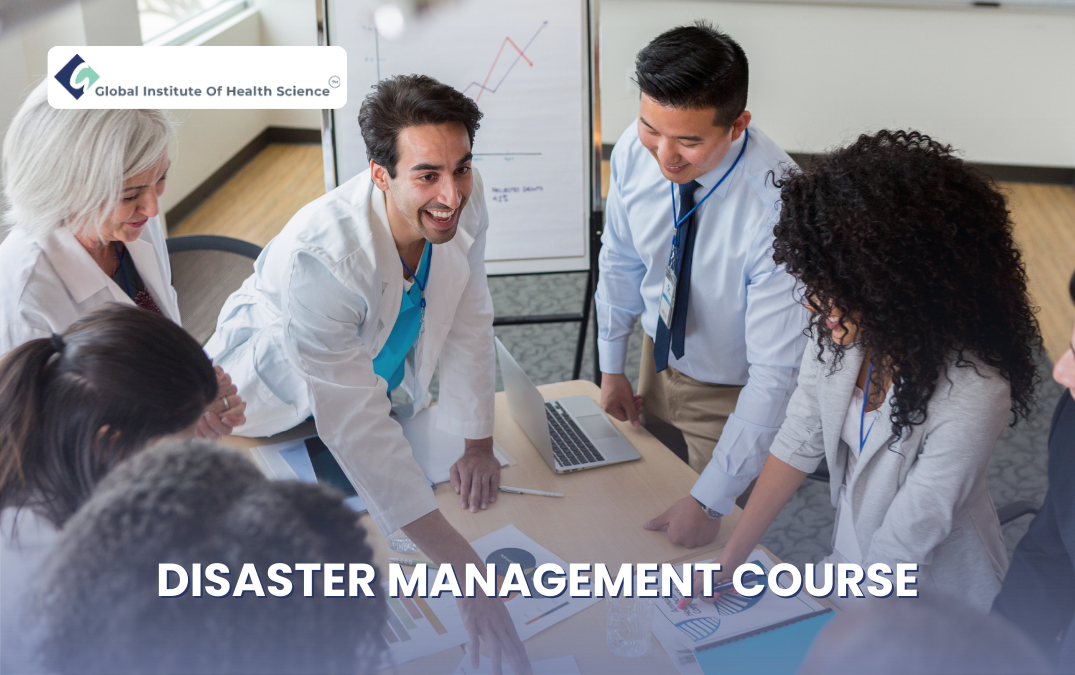
Disaster and emergency can knock on a door anytime without any prior notice, it can be both natural and manmade; hence it is always necessary to be ready with an appropriate management plan to handle the hazard and crises caused. Disaster management can be defined as the management and organization of responsibilities and available resources for coping with various altruistic aspects of emergencies. National Disaster Management Authority, abbreviated as NDMA, is a regulatory Body of the Government of India, with a mandate to lay down policies for disaster management Moreover, The National Disaster Management Act (NDMA, India), 2005 is mandatory for all hospitals in India to have a disaster management contingency plan. This program explores the theoretical and practical aspects of disaster and emergency management, and the course covers the management for risk reduction, mitigation, preparedness, response, recovery, and reconstruction by providing the opportunity to plan and prepare.
Syllabus
- Healthcare & Hospital Management
- Hazards, Risks and Disasters
- Field Skills
- Disaster Theory, Statistics and Logistics
- Disaster Mitigation, Preparedness and Response
- Earth catastrophes, Fire and Explosion
- Understanding Natural and Man-made Disasters
- Disaster Medicine
- Rehabilitation, Reconstruction and Recovery
- Strategies for Survival
- Risk Analysis Techniques
- Resources Analysis and Mobilization
- The Experience of Vulnerability
- Disaster Preparedness (various aspects)
- Logistics Management
- Communication, Participation, and Activation of the Emergency Preparedness Plan
Disaster management for hospitals and healthcare organizations
Disaster and emergency can knock on a door anytime without any prior notice, it can be both natural and manmade; hence it is always necessary to be ready with an appropriate management plan to handle the hazard and crises caused. Disaster management can be defined as the management and organization of responsibilities and available resources for coping with various altruistic aspects of emergencies. National Disaster Management Authority, abbreviated as NDMA, is a regulatory Body of the Government of India, with a mandate to lay down policies for disaster management Moreover, The National Disaster Management Act (NDMA, India), 2005 is mandatory for all hospitals in India to have a disaster management contingency plan.
Course Objective
The certified GIHS disaster management online course in India is to enlighten the aspects of how to reduce or avoid potential loss and reduce the disaster. This program explores the theoretical and practical aspects of disaster and emergency management, and the course covers the management for risk reduction, mitigation, preparedness, response, recovery, and reconstruction by providing the opportunity to plan and prepare. Disasters and mass casualties can cause great loss and inefficiency in hospitals and healthcare organizations. It helps and prepares the reserve medical and administrative staff network readiness.
Eligibility
- All Science Graduates, MBBS, BDS, BHMS, BAMS, BPT, BUMS, B.SC., M.SC., Life science, IT Professionals, Medical Laboratory, Nursing, Microbiology, Biomedical, Biotech and all professionals working with Hospitals & Healthcare Organizations.
Mode or Methodology
- Online & Distance Learning
Certification
- GIHS Certificate would be awarded to only successful candidates.
Examination
- Online & Distance Exams (MCQ / Theoretical) / Projects
Placement Assurance
- Successful candidates would get the placement support. CVs of successful candidates would be forwarded to various Organizations.
Career Options
Safety officer in Healthcare & Other Industries
Disaster and Emergency officer
Disaster Recovery Manager
Emergency Medical Technician
Fees, Payment & Program Duration
Certificate Program
- Duration : 3 Months
- Foundation-level program
- Core concept learning
- Industry awareness focus
- Expert-designed syllabus
- Research-based curriculum
- Academic & tech support
- Skill development course
- Govt-recognized program
- Global accreditation & recognition
- Globally ISO certified
- ₹22,999 For Indian Candidates
- $450* USD For International Candidates
Post Graduate Diploma Program
- Duration : 1 Year
- Advanced-level professional course
- Comprehensive concept mastery
- Research-based modules
- Lifetime expert support
- Job & career assistance
- Free Career Boost (www.TopCVCoach.com)
- High employment potential
- Govt-recognized program
- Global accreditation & recognition
- Globally ISO certified
- ₹32,999 For Indian Candidates
- $699* USD For International Candidates
*Fees subject to taxes & exchange rates.
Fast Track PG Diploma Program
- Duration : 4 Months
- Accelerated PG-level program
- Flexible learning format
- Self-paced completion
- Lifetime expert support
- Research-driven curriculum
- Free Career Boost (www.TopCVCoach.com)
- Job-oriented training
- Govt-recognized program
- Global accreditation & recognition
- Globally ISO certified
- ₹36,999 For Indian Candidates
- $750* USD For International Candidates
*Fees subject to taxes & exchange rates.
- Cheque / Demand Draft / Cash in the name of “Global Institute of Health Science”
- Online Transfer through NEFT or RTGS
- Fee can also be deposited in GIHS bank account
- Disclaimer: This course details are for the purpose of awareness about the program and career opportunities. The exact information on course structure may vary from this information.
Join GIHS Programs now and unlock an exclusive FREE TopCV Coach access worth ₹9,999/-
Frequently Asked Questions
Disaster management in hospitals involves systematic planning, preparation, response, and recovery strategies to mitigate the impact of disasters or emergencies on healthcare facilities. It aims to ensure the continuity of healthcare services and the safety of patients, staff, and the community.
Internal disasters in hospitals may include events such as fires, structural failures, or equipment malfunctions. External disasters encompass events like natural disasters, mass casualty incidents, infectious disease outbreaks, or acts of terrorism.
Hospital disaster management is a collaborative effort involving various teams. The responsibility typically falls on a multidisciplinary team, including hospital administrators, emergency response teams, medical staff, and local emergency management authorities.
Disaster management in hospitals offers benefits such as improved preparedness, reduced casualties, efficient allocation of resources, minimizing damage to infrastructure, effective communication, and the ability to resume critical healthcare services swiftly.
The three phases of disaster management in a hospital are preparedness (planning, training, and equipping the hospital for potential disasters); response (immediate actions taken during and after a disaster to save lives and reduce damage); and recovery (long-term efforts to restore normal hospital operations, support affected individuals, and implement lessons learned for future preparedness).
Real Stories. Real Achievements
Where Our Graduates Are Making an Impact


Why Choose GIHS?
Bringing Excellence To Health Professionals
15+ Years Of Industry Experience
ISO & Government Certified Institute
Personalized Tutoring For Success
Request More Information
- Course details & eligibility
- Admission process & fees
- Career prospects & certifications
- Flexible learning options